by Vito Ferrero, Architect-Designer/vr-immersive.com
The impression that architecture and design is progressively
going into an “effect driven” industry or as a “mediatic art” is to me, not a
sign of degradation of the discipline but only a logical and transient stage in
the maturity process of a global culture that now has these wonderful new tools
to express itself. This proliferation of images, spectacular
buildings, vehicles, outrageous forms that amuse the eye is perfectly natural
when not long ago we were bound to the limits of 2D representation through ink
and paper or to the slow and full of sacrifice world of unassisted
craftsmanship. 3D technology including 3D printing and VR technologies, have a
liberating effect that also has its growing pains in the competitive mind, but
on the other hand, enhances the potential for collaboration and problem solving
in graceful ways, like in no other time in history. We are indeed very lucky to
be living in a time were such flourishment of opportunity is expanding.
Digital resources as VR can expand our capabilities as
designers, to attract and convince clients, to better inform and coordinate
with developers and entrepreneurs. Innovation in the application of this
technology is on its verge and anyone with enough vision can sense we are on
the top of the wave to make bold moves to promote research and development in
any possible VR application.
Back in time, the development of CAD and BIM software
expanded the paradigms of design when they came. In parallel, 3D and render
apps expanded the paradigm much more. So now we find that 2D plans are not
enough to convey the complex ideas of generative architecture, freeform
surfaces and other interesting and complex manifestations, relatively new
expressions of architectural art nowadays.
But even for the convenience, practicality, speed and ease
that VR technology has to communicate design ideas, especially in architecture
and industrial design, its applications
take hold on more conventional, not-so-spectacular architecture as well, and can
be oriented at the market of real estate and tourism as well passing through
interior design and decoration.
The meaning of the word architecture is broadening, to an
art-less rigid, more interconnected and interpenetrated with other disciplines,
like plastic art, sculpture, product and service development, sustainability,
energy, invention, business, or even high-tech engineering.
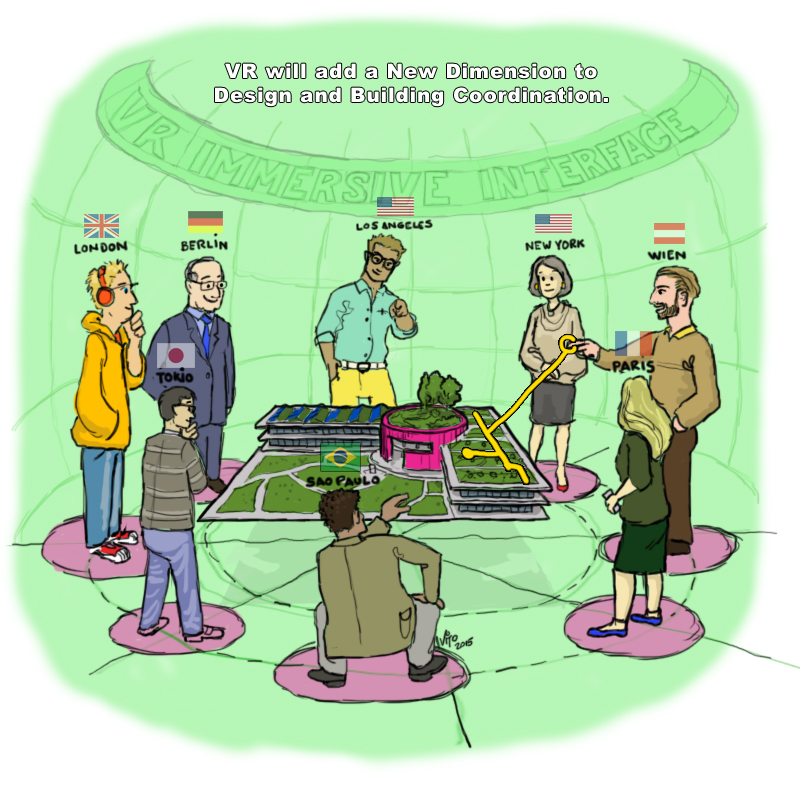
Also on a technical level the potential is tremendous. The
use of virtual conference rooms, where avatars of distant people can meet over
the internet and discuss about modifications of complex 3D models, part
assemblies, project management, timing, costs and implications of different
options and also communication with clients, potentially gives a flexibility
unsurpassed in any other time of history. Also the effectiveness of
consultations, coordination, explanation and approval of projects can speed up
the curve of completion to a great extent.
The cost of these technologies also is going to be
progressively affordable, coming in a wide range and variety.
It’s only a matter of time for all the pieces to take place
and interlock, realizing all these applications and more. And to foresee, and
then learn and implement this opportunities is going to be a key to success in
the future of design and industry. VF.
About VR-Immersive.com:
We are a German-Spanish start-up, which develops virtual reality
content and a proprietary platform, operating system and hardware
agnostic, applicable in sectors such as real estate, tourism, yachts,
design, edutainment, health, etc. This is how we do it - follow us on Facebook, Twitter, LinkedIn, YouTube oder Xing.